Step-by-step knitting instructions
The model is presented in three sizes: 1 (42–44), 2 (46–50), and 3 (52–54). The chest circumference for these sizes is 82–89 cm, 90–102 cm, and 103–114 cm, respectively. Finished garment width: 93 cm, 106.5 cm, and 121 cm. Chart 1 gives detailed measurements in centimeters, but some values in the original text are damaged — refer to the attached image. Approximate garment length: 23.3 / 26.6 / 30.2 cm (the value in the source is incomplete; check the chart).

Yarn recommendations
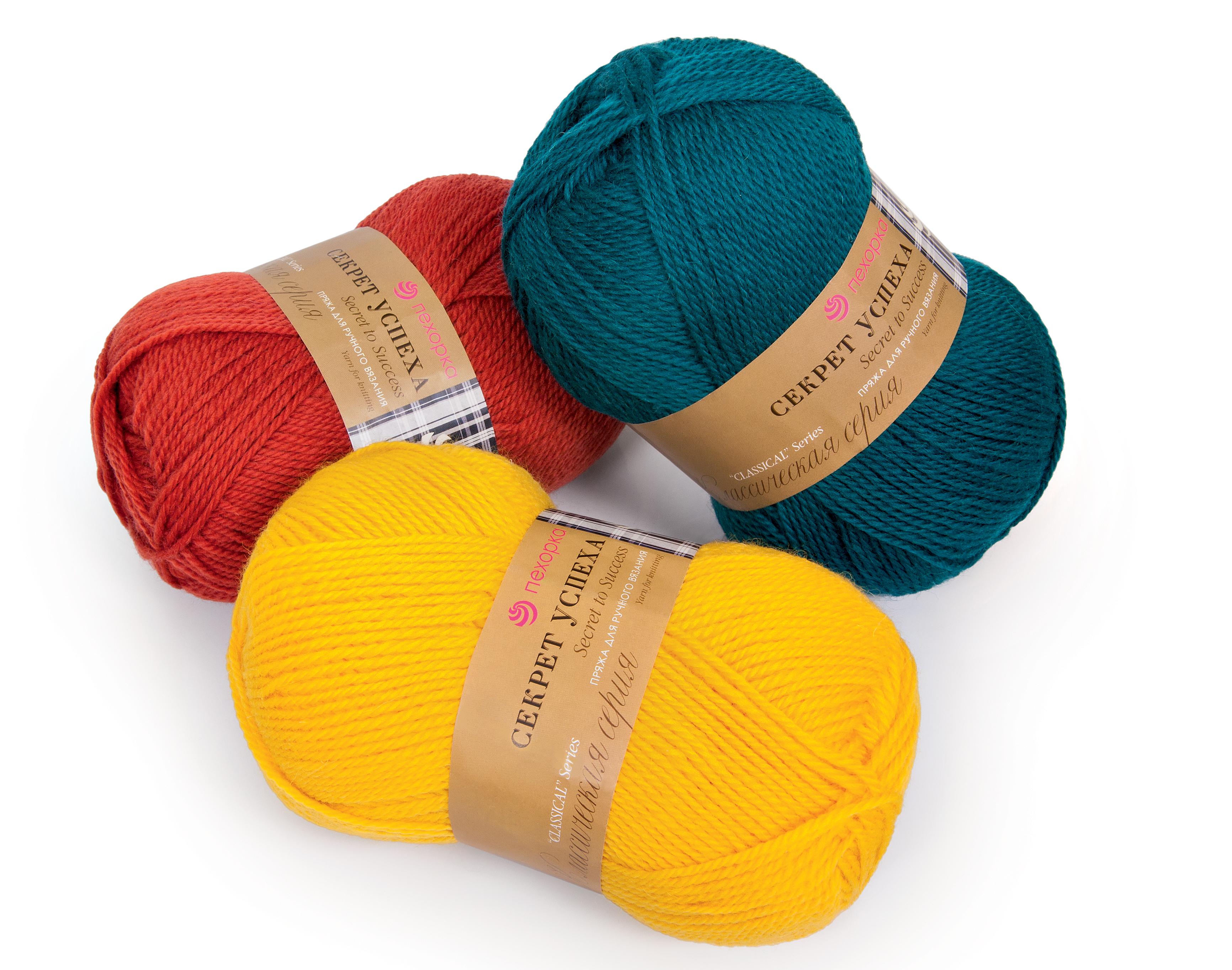
Any summer yarn made of cotton, viscose, or linen with a yardage of about 100–140 m per 50 g will work. The consumption is given by size.
- Laines du Nord PIMA COTTON: 100% mercerized Pima cotton, Italy, 125 m / 50 g — 250 / 300 / 350 g.
- Katia BRISA: 60% cotton, 40% viscose, Spain, 125 m / 50 g — 250 / 300 / 350 g.
- Katia Versailles: 7% viscose, 2% polyester, 1% polyamide, Spain, 100 m / 50 g — 250 / 300 / 350 g.
- Lana Grossa PORTOFINO: cotton with a glossy effect, 60% cotton, 40% polyamide, 115 m / 50 g — 250 / 300 / 350 g.
- Lana Grossa 365 COTONE: 88% cotton, 12% polyamide, 140 m / 50 g — 200 / 250 / 300 g.
- Lana Grossa BOTTONE: matte yarn with slubs and a linen shade, 94% cotton, 6% polyamide, 120 m / 50 g — 250 / 300 / 350 g.
- Lana Grossa COOL COTTON: classic cotton with elastane, 93% cotton, 7% polyester, 105 m / 50 g — 250 / 300 / 350 g.
- Lana Grossa LINARTE: linen yarn with cotton, 40% viscose, 30% cotton, 20% linen, 10% polyamide, 125 m / 50 g — 250 / 300 / 350 g.
- Lana Grossa PIMA: 100% cotton, 125 m / 50 g — 250 / 300 / 350 g.
- Lana Grossa ALLEGRO Unito: matte cotton with shiny viscose, 58% viscose, 42% cotton, 115 m / 50 g — 250 / 300 / 350 g.
- Katia Malibu Plus: 76% cotton, 24% acrylic, 135 m / 50 g — 250 / 300 / 350 g.
- Katia Lunis: 54% cotton, 46% polyamide, 120 m / 50 g — 250 / 300 / 350 g.
- Katia All Seasons Cotton: 100% cotton, 130 m / 50 g — 250 / 300 / 350 g.
- Illaria SAHARA MAKO: fine cotton tape with uniform slubs, 100% cotton, 100 m / 50 g — 250 / 300 / 350 g.
- Illaria SOLARE: 55% cotton, 45% viscose, 100 m / 50 g — 250 / 300 / 350 g.
- Le fil Mare: 55% Egyptian cotton, 45% viscose, 115 m / 50 g — 250 / 300 / 350 g.
- GAZZAL ORGANIC BABY COTTON: 100% organic cotton, 80 m / 50 g — 300 / 350 / 400 g.
- DROPS Muskat: mercerized cotton, 100%, 80 m / 50 g — 300 / 350 / 400 g.
- DROPS Bomull-Lin: 53% cotton, 47% linen, 80 m / 50 g — 300 / 350 / 400 g.
Tools
Circular needles size 4.5 or 5 with an 80–120 cm cable (depending on your gauge), crochet hook 3–5 mm, blunt-tipped needle with a large eye, sharp-tipped needle with a large eye, scissors, tape measure, markers.
Patterns and basic techniques
Stockinette stitch — in circular knitting, work knit stitches through the front loop.
Half-patent pattern — in flat knitting:
Row 1: slip 1 knitwise without knitting (a knit stitch with the working strand behind), working yarn behind the work, p1. Alternate the knit stitch with the working strand behind and the purl stitch.
Row 2: knit the knit stitches and purl the purl stitches (see video 1).
In circular knitting:
Row 1: slip 1 knitwise without knitting (a knit stitch with the working strand behind), working yarn behind the work, p1. Alternate the knit stitch with the working strand behind and the purl stitch.
Row 2: knit the knit stitches and purl the purl stitches without carried strands (see video 3).
Left-leaning decrease of two knit stitches — slip the first stitch to the right needle without knitting, knit the second stitch, and pass the first stitch over the second (see video 7).
Right-leaning decrease of two knit stitches — k2tog through the front loops (see video 5).
Short row — a technique in which part of the fabric is worked in more rows than the rest. The instructions use the German short row technique. From the beginning of the row, work all stitches in pattern to the turning point. Turn the work to the wrong side, slip the first stitch to the right needle, pull the working yarn back toward the RS so that 2 legs of the stitch from the previous row appear. Work all subsequent stitches purlwise to the turning point in the WS row. The 2 legs of the pulled stitch are worked together knitwise on RS rows and together purlwise on the WS.
Stitch-to-stitch grafting on open stitches is used to join the shoulder slopes. Place the pieces with open stitches opposite each other on a flat surface and join the stitches, picking them up directly from the needles. Graft from right to left on the RS with the same yarn used to knit the garment. The yarn length should be 3–4 times longer than the row being joined. Keep the yarn tension even so that the fabric does not pull. Work the seam as follows: secure the yarn on the lower piece on the right, insert the needle into the first stitch from the WS, then pass alternately through two stitches of the lower and upper rows, slipping the grafted stitches off the needles.
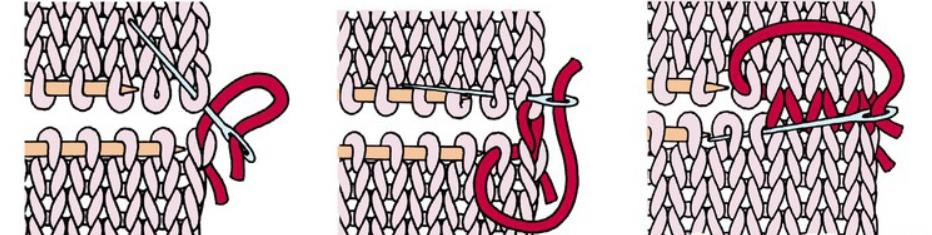
Methods for joining summer yarn: you can thread the ends into each other with a needle (sew them without leaving knots); a hollow cord is sewn to itself; if the yarn is in the form of a chain, it is unraveled and joined with a crochet hook; you can also introduce a new ball parallel to the ending yarn, knit 4–6 stitches with two strands, then continue with one.
Gauge (stockinette stitch, after blocking): 20 stitches × 30 rows = 10 cm × 10 cm. Be sure to knit a swatch, wash it, and match the specified gauge — it is adjusted by needle size.
Working order
Step 1. On size 4.5 or 5 needles, CO separately 97/113/129 sts for the front and 97/113/127 sts for the back (depending on size). You can work both pieces in parallel or one after the other.
Step 2. Work 2 rows in 1×1 ribbing (1 knit, 1 purl), with a knit stitch after the edge stitch in the first row.
Step 3. In the 3rd row, distribute the stitches as follows:
- Front: 7 sts in half-patent pattern (right side placket), 35/43/51 sts in stockinette stitch, 13 sts in half-patent pattern (center placket), 35/43/51 sts in stockinette stitch, 7 sts in half-patent pattern (left side placket).
- Back: 7 sts in half-patent pattern (right side placket), 83/99/113 sts in stockinette stitch, 7 sts in half-patent pattern (left side placket).
Work in this way for 8–9 cm.
Step 4. Join the back and front into a round, working 2 edge stitches together purlwise on each side. After joining, there should be 192/224/254 sts on the needles. Work in pattern for 37/38/39 cm from the beginning of knitting, noting that the half-patent pattern is worked differently in circular knitting (see the description above).
Step 5. Divide the knitting into front and back at the side plackets and continue working back and forth in rows. The 7 sts of the half-patent pattern are distributed to the front on the right and left. On the back side, increase 1 st in each side placket so that the back also has 7 placket sts on each side, including the edge stitches. The number of front sts is 97/113/129, and of back sts is 97/113/127.
Step 6. Front. After dividing, work back and forth in rows in pattern: 7 sts in half-patent pattern, 35/43/51 sts in stockinette stitch, 13 sts in half-patent pattern (center placket), 35/43/51 sts in stockinette stitch, 7 sts in half-patent pattern. After 2 rows, divide the front into right and left front pieces at the center placket: assign the first 7 placket sts to the right front and 6 to the left. When working the first row after the division, add 1 st to the neckline placket (the seventh). Thus, each front piece will have 49/57/65 sts.
Work the decreases simultaneously at the armhole and neckline, at the boundary between the placket and stockinette stitch (the stockinette stitches are decreased). Decrease schedule:
- Size 1: armhole — 4 decreases in every row, then 3 decreases in every 2nd row, then 3 decreases in every 4th row; neckline — 4 decreases in every row and 20 decreases in every 2nd row.
- Size 2: armhole — 6 decreases in every row, then 3 decreases in every 2nd row, then 3 decreases in every 4th row; neckline — 6 decreases in every row and 22 decreases in every 2nd row.
- Size 3: armhole — 8 decreases in every row, then 3 decreases in every 2nd row, then 3 decreases in every 4th row; neckline — 8 decreases in every row and 24 decreases in every 2nd row.
Work the decreases at the right armhole with a right-leaning decrease, and at the left armhole with a left-leaning decrease. At the neckline, use left-leaning decreases on the right front and right-leaning decreases on the left front. After all decreases are complete, 15/17/19 sts will remain on each side. Work the straps in half-patent pattern for another 7 cm on each side. Be sure to try the garment on and, if desired, adjust the strap length.
Step 7. Back. After dividing, there are 97/113/127 sts on the needles. From the first row, begin armhole decreases on both sides simultaneously:
- Size 1: 4 decreases in every row, then 3 decreases in every 2nd row, then 3 decreases in every 4th row.
- Size 2: 6 decreases in every row, then 3 decreases in every 2nd row, then 3 decreases in every 4th row.
- Size 3: 8 decreases in every row, then 3 decreases in every 2nd row, then 3 decreases in every 4th row.
The direction of decreases is as on the front. After all decreases, 77/89/99 sts should remain on the needles. Begin shaping the rounded back neckline. Place 4 markers:
- Size 1: between stitches 15 and 16, 35 and 36, 42 and 43, 62 and 63.
- Size 2: between stitches 17 and 18, 37 and 38, 52 and 53, 72 and 73.
- Size 3: between stitches 19 and 20, 39 and 40, 60 and 61, 80 and 81.
Work short rows using the German short row technique. For the right side of the neckline: work to the 1st marker, knit 15 sts (leaving 5 sts unworked before the 2nd marker), turn, make a double stitch, and work to the end of the row. In the next RS row, after the 1st marker, knit 10 sts (leaving 10 unworked), then 5 sts (leaving 15 unworked), then turn, leaving 20 sts unworked before the 2nd marker, and work the row to the end. In the final row, work all stitches in pattern, working the double stitches together knitwise with a right-leaning decrease. Work the left side mirror symmetrically, working the double stitches together purlwise on the WS row. After that, work 15/17/19 strap sts in half-patent pattern and BO all stitches between the 1st and 4th markers.
Step 8. Straps. Work the straps from the back side for 11 cm. Try the garment on and change the length if necessary. Graft the straps with Kitchener stitch.
Step 9. Finishing. If the lower edge of the garment and the back neckline curl (this is normal for stockinette stitch), crochet around the neckline edge and the lower edge of the garment. Hide the yarn ends and block the garment.
Step 10. Garment care. Hand wash at about 30°C with mild liquid detergents, without bleaches. Do not rub or wring. Wrap the washed garment in a dry terry towel for 5–10 minutes, then lay it flat horizontally on a dry towel. Do not dry it hanging or on radiators. Iron through a damp cotton cloth with an iron up to 130°C; do not steam textured patterns. Store the garment folded on a shelf; do not hang it on hangers.